Webhook
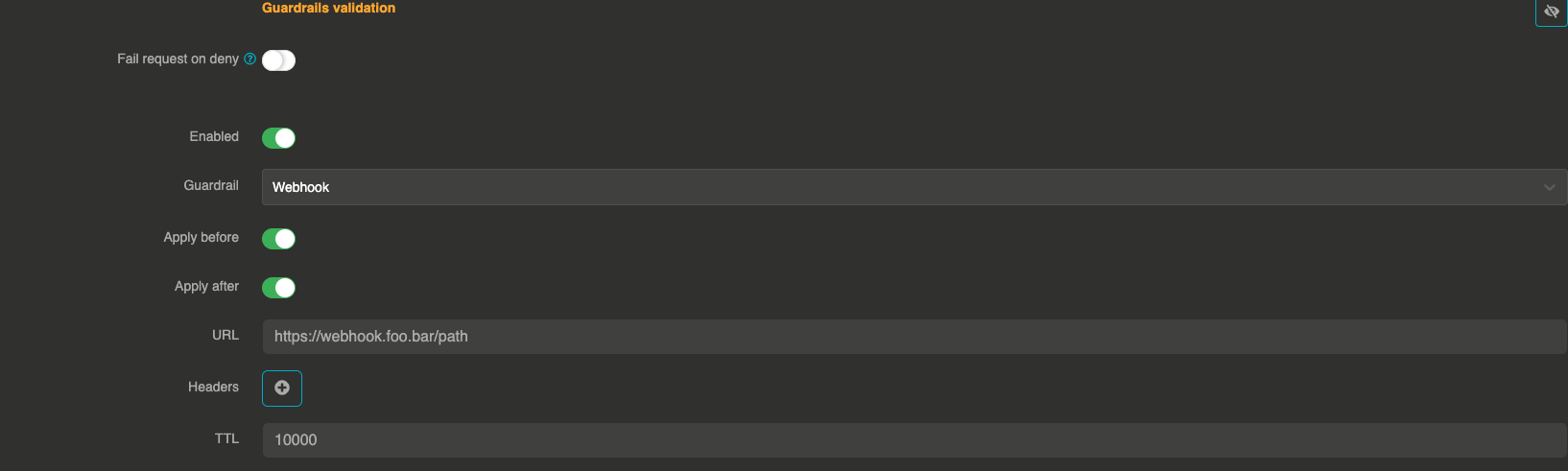
The Webhook guardrail delegates content validation to an external HTTP service. This allows you to implement custom validation logic in any language or framework by exposing a simple HTTP endpoint.
This guardrail can only be applied before sending the prompt to the LLM (not after).
How it works
- The guardrail sends a
POSTrequest to the configured URL with the messages array as the JSON body - If the response status is
200and the response body contains{"result": true}, the message passes - Any non-200 status or
{"result": false}causes the message to be denied - Results are cached with a configurable TTL to avoid calling the webhook for duplicate messages
Configuration
"guardrails": [
  {
    "enabled": true,
    "before": true,
    "after": false,
    "id": "webhook",
    "config": {
      "url": "https://my-validation-service.example.com/validate",
      "headers": {
        "Authorization": "Bearer my-secret-token"
      },
      "ttl": 60000
    }
  }
]
Field explanations
- enabled:
true— The guardrail is active - before:
true— The guardrail applies to user input before sending to the LLM - after:
false— This guardrail only works on incoming requests (before phase)
Config section
| Parameter | Type | Required | Default | Description |
|---|---|---|---|---|
url | string | Yes | — | The URL of the external validation service |
headers | object | No | {} | HTTP headers to include in the webhook request (e.g. for authentication) |
ttl | number | No | — | Cache duration in milliseconds for validation results. Identical messages will use cached results within this window. |
Webhook request format
The guardrail sends a POST request with a JSON array of messages:
[
  {
    "role": "user",
    "content": "the user message"
  }
]
Expected webhook response
The webhook must return a 200 status code with a JSON body:
{
  "result": true
}
{"result": true}— the message passes{"result": false}or any non-200 status — the message is denied
Caching
Validation results are cached based on a SHA-512 hash of the messages. This means identical message sequences will not trigger a new webhook call within the TTL window, reducing latency and load on the external service. The cache holds up to 5000 entries.