Semantic contains
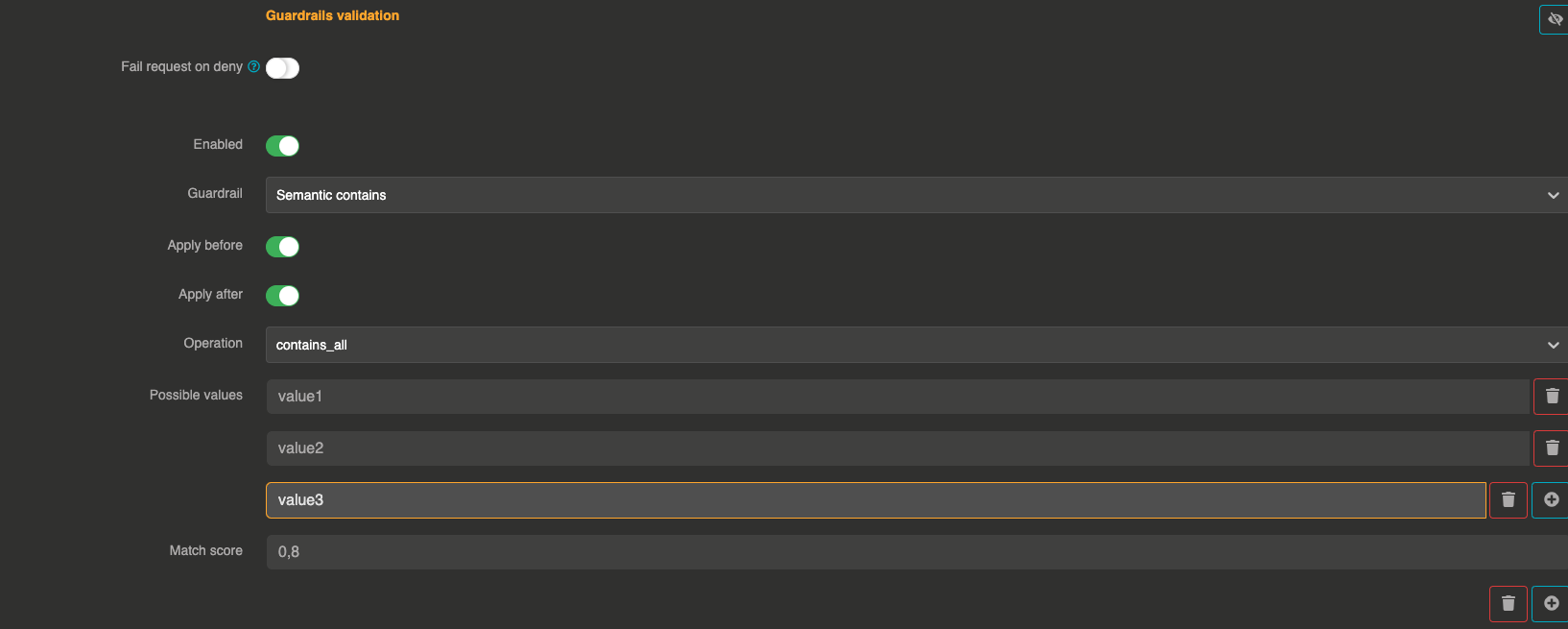
The Semantic contains guardrail checks whether the message content is semantically similar to specified values, using embedding-based similarity rather than exact text matching. This is more flexible than the Text contains guardrail because it can detect meaning even when the exact words differ.
It can be applied before sending the prompt to the LLM and after to validate the LLM response.
How it works
The guardrail uses the AllMiniLmL6V2 embedding model (runs locally, no external API call) to compute semantic similarity between the message and the configured values. A similarity score threshold determines whether two texts are considered semantically equivalent.
The matching logic supports the same operations as the Text contains guardrail:
| Operation | Description |
|---|---|
contains_all | The message must be semantically similar to all specified values (default) |
contains_none | The message must not be semantically similar to any of the specified values |
contains_any | The message must be semantically similar to at least one of the specified values |
Configuration
"guardrails": [
  {
    "enabled": true,
    "before": true,
    "after": true,
    "id": "semantic_contains",
    "config": {
      "operation": "contains_none",
      "values": ["how to hack a system", "bypass security"],
      "score": 0.8
    }
  }
]
Field explanations
- enabled:
true— The guardrail is active - before:
true— The guardrail applies to user input before sending to the LLM - after:
true— The guardrail applies to the LLM response
Config section
| Parameter | Type | Required | Default | Description |
|---|---|---|---|---|
operation | string | No | "contains_all" | The matching operation: contains_all, contains_none, or contains_any |
values | array of strings | No | [] | The list of text values to compare semantically with the message content |
score | number | No | 0.8 | Minimum similarity score (0.0 to 1.0) for two texts to be considered semantically equivalent. A higher score requires closer semantic similarity. |
Guardrail example
With operation: "contains_none" and values: ["how to hack a system"]:
"Tell me how to break into a computer"— blocked (semantically similar to hacking)"What's the weather today?"— passes (not semantically related)
Performance
This guardrail runs the embedding model locally using ONNX, so it does not make any external API calls. This means it is fast and cost-free, but it adds some CPU overhead for the embedding computation.