Crawlers and AI agents
Threat Protection → Bot policies.
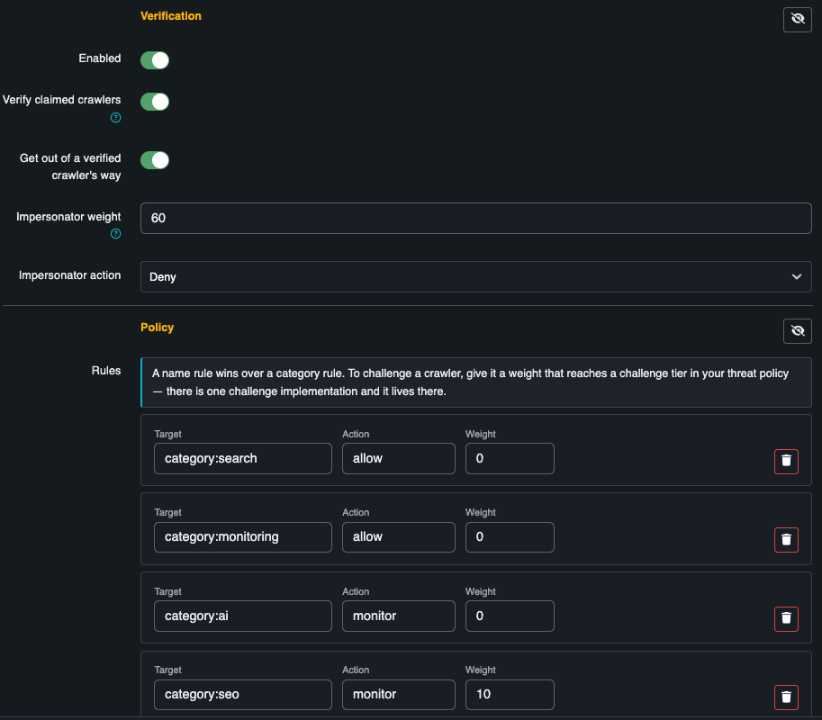
Verify claimed crawlers is what turns a user-agent string into a checked claim; Impersonator action is what happens when the check fails. Below it, the per-category rules — search and
monitoring allowed, AI and SEO merely scored.
Verification is the valuable half
Googlebot is the most forged user-agent string on the web. A policy built on the string alone is a
policy anyone can opt into by typing eleven characters.
For the crawlers that publish a verification method, the policy does forward-confirmed reverse DNS: resolve the address to a name, check the name belongs to the operator, then resolve that name back and check it returns to the same address. One direction alone proves nothing — a reverse record is set by whoever owns the address block.
Three outcomes:
| Outcome | What it means | Default |
|---|---|---|
| Verified | It is who it says | Get out of its way |
| Impersonator | A demonstrated lie, not a heuristic | Weight 60, and denied |
| Unknown | Not resolved yet, or no method published | The category rule applies |
DNS blocks, and the request path is not allowed to block. The first request from an address
schedules the lookup and answers unknown; the next one has the answer. A crawler makes thousands
of requests, so being one request late costs nothing — while a per-request DNS round trip would
cost everything.
A DNS failure yields unknown, never impersonator. A resolver problem is not evidence.
AI crawlers
The catalog covers the ones people actually ask about — GPTBot, ClaudeBot, CCBot, PerplexityBot, Bytespider, Amazonbot, Google-Extended, Applebot-Extended and more.
None of them publishes a verification method. That is itself the finding: any policy on an AI
crawler rests entirely on a string it chooses to send, and enforcement at the gateway is what makes
a robots.txt line more than a polite request.
{
  "rules": [
    { "target": "category:search", "action": "allow", "weight": 0 },
    { "target": "category:ai", "action": "deny", "weight": 0 },
    { "target": "name:ccbot", "action": "allow", "weight": 0 }
  ]
}
A name: rule beats a category: rule, so the example above blocks AI crawlers except CCBot.
Actions are allow, monitor and deny. There is no challenge action here — to challenge a
crawler, give it a weight that reaches a challenge tier in your
threat policy. One challenge implementation, one place to reason about it.
The shipped defaults deny nothing: a policy that starts blocking crawlers the moment you install it is a trap.
robots.txt, generated
The policy generates the robots.txt matching what it actually enforces, so the file and the
gateway cannot drift apart — which is the usual failure of a robots.txt nobody enforces.
Press Generate on the policy page, or POST /_robots_txt. Serve the result with Otoroshi's own
Robots plugin; this extension deliberately does not duplicate the serving.
An llms_txt field is carried alongside for the same purpose.