Challenges
Between "log it" and "refuse it" there is a third option: ask. A challenge costs a real visitor a fraction of a second, once, and costs an automated client CPU on every single request. That asymmetry is the whole point.
Threat Protection → Challenge providers.
Proof of work, built in
The default kind is pow and it involves nobody else: the browser computes a hashcash-style
SHA-256 puzzle, we verify the answer, and a signed cookie grants clearance for a while.
No third-party service. No external script. No personal data. No consent banner. That is what makes it deployable in European enterprise and public-sector contexts where a CAPTCHA vendor is a procurement conversation rather than a config change.
| Field | Default | What it does |
|---|---|---|
difficulty_floor | 18 | Leading zero bits demanded at score 0 |
difficulty_ceiling | 24 | At score 100 |
challenge_ttl_seconds | 300 | How long a puzzle stays solvable |
clearance_ttl_seconds | 1800 | How long a solved challenge lasts |
bind_ip / bind_ua | true | Clearance is tied to the caller who earned it |
Difficulty scales with the threat score. Each bit doubles the expected work, so the range is deliberately narrow — roughly a quarter of a second to a few seconds on a phone. A wider range is not "more secure", it is a denial of service against your own users.
Puzzles are one-shot. A challenge is stored and consumed on use, so a solution cannot be replayed. A stateless, self-signed challenge could be solved once and reused forever across the cluster, which turns the whole scheme into a formality.
Clearance is bound to the caller. Without that, a scraping farm solves once and shares the cookie across every worker.
Wiring it up
A challenge is a threat policy tier action:
{
  "challenge_provider": "challenge-provider_...",
  "tiers": [
    { "min_score": 40, "action": "log" },
    { "min_score": 60, "action": "challenge" },
    { "min_score": 90, "action": "ban" }
  ]
}
The threat response plugin serves the interstitial, the browser solves it and posts the answer back to the same URL, and the reloaded request carries the clearance cookie.
The solution is posted to the same URL it was challenged on, so anything that would refuse that request before the response plugin sees it — an authentication plugin, for instance — also refuses the answer. Challenges belong in front of public routes.
Vendor backends
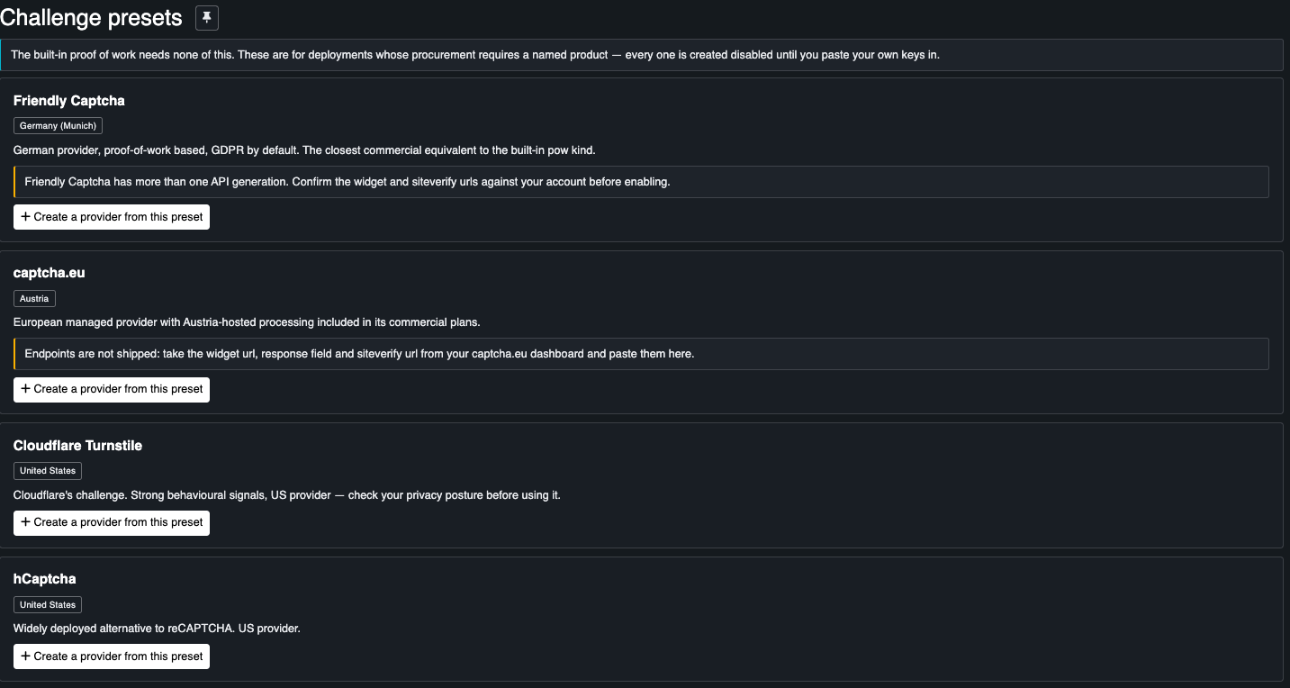
Every preset is created disabled until you paste your own keys in, and each is labelled with where it runs — which for a European deployment is usually the deciding factor.
For deployments whose procurement requires a named product. Set the kind to vendor and fill in a
widget script, the response field name, a siteverify URL and your keys.
There is deliberately no per-vendor code: a vendor is a handful of URLs and field names, which makes adding one a configuration change and stops this extension shipping hardcoded endpoints that quietly rot.
Threat Protection → Challenge presets ships ready-to-edit settings:
| Preset | Operated from | Note |
|---|---|---|
| Friendly Captcha | Germany (Munich) | Proof-of-work based, GDPR by default — the closest commercial equivalent to the built-in kind |
| captcha.eu | Austria | Endpoints are not shipped: take them from your dashboard |
| Cloudflare Turnstile | United States | Strong behavioural signals; check your privacy posture |
| hCaptcha | United States |
Every preset is created disabled. A challenge that cannot verify would lock out every caller it challenges, so one without keys must not be able to run.
Vendor verification fails closed: if the provider cannot be reached, the answer is refused. That is the opposite of the rule everywhere else in this extension, and deliberately so — failing open here would mean anyone could pass a challenge by blocking one outbound request.
What is not here
An image or interactive puzzle of our own. Distorted text is solved at over 99% by commodity models, human solver farms cost about a dollar per thousand, and a visual puzzle without an audio alternative excludes blind users — a legal exposure under the European Accessibility Act, not just an ethical one. It would be security theatre with a liability attached.
Behavioural risk scoring. What makes the big vendors work is a view of traffic across hundreds of thousands of sites. That is a data problem, not a code problem.
We do not need it: the gateway already sees every request, the WAF verdicts, the reputation feeds and the ledger. The risk engine is the fabric. What a CAPTCHA adds here is friction, not judgement.