Load Balancing
Load balancing distributes LLM requests across multiple providers, optimizing performance, ensuring availability, and preventing any single provider from being overloaded.
How it works
The load balancer is a virtual provider of type loadbalancer. Instead of connecting directly to an LLM API, it wraps multiple real providers and routes each request to one of them according to a configurable strategy.
It supports all LLM operations: chat completion (blocking and streaming) and text completion (blocking and streaming).
A request counts against the budgets of the load balancer and against those of the provider that served it: a budget on the load balancer caps everything going through it.
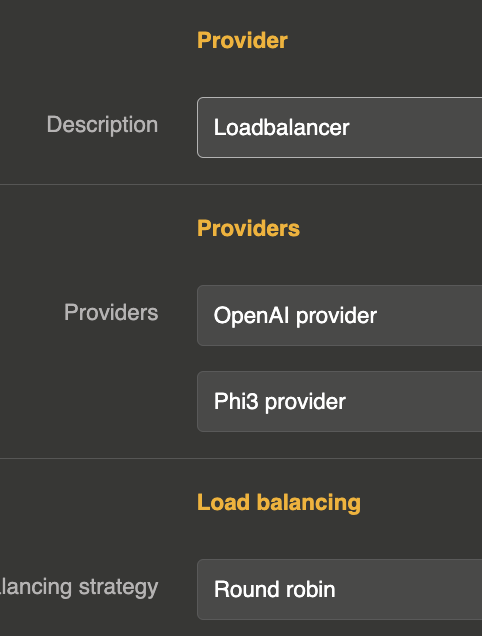
Creating a load balancer provider
Create a new LLM Provider entity with provider set to loadbalancer. The connection object is not used. All configuration goes into the options object.
{
  "id": "provider_lb_1",
  "name": "My Load Balancer",
  "provider": "loadbalancer",
  "connection": {},
  "options": {
    "refs": [
      "provider_openai_1",
      "provider_anthropic_1",
      "provider_mistral_1"
    ],
    "loadbalancing": "round_robin"
  }
}
Configuration
| Parameter | Type | Default | Description |
|---|---|---|---|
refs | array | [] | List of provider references (see below) |
loadbalancing | string | round_robin | Load balancing strategy: round_robin, random, or best_response_time |
selector_expr | string | — | Expression to filter providers based on request content (see below) |
Provider references
The refs array can contain either simple provider IDs (strings) or objects with weight, selector and model:
Simple format — each provider has equal weight:
{
  "refs": [
    "provider_openai_1",
    "provider_anthropic_1"
  ]
}
Weighted format — control traffic distribution with weights:
{
  "refs": [
    { "ref": "provider_openai_1", "weight": 3 },
    { "ref": "provider_anthropic_1", "weight": 1 }
  ]
}
In this example, OpenAI would receive approximately 75% of requests and Anthropic 25%.
With selector — filter providers based on request content:
{
  "refs": [
    { "ref": "provider_openai_1", "weight": 1, "selector_expected": "openai" },
    { "ref": "provider_anthropic_1", "weight": 1, "selector_expected": "anthropic" }
  ],
  "selector_expr": "model"
}
With a model — spread the traffic over several models, even of the same provider:
{
  "refs": [
    { "ref": "provider_openai_1", "weight": 3, "model": "gpt-4o-mini" },
    { "ref": "provider_openai_1", "weight": 1, "model": "gpt-4o" }
  ]
}
A target without model uses the default model of its provider. A target with a model always uses it, even
when the request asks for another model.
Load balancing strategies
Round Robin
Distributes requests sequentially across all providers in order. Each provider gets an equal share of traffic (adjusted by weights).
{
  "loadbalancing": "round_robin"
}
Random
Selects a random provider for each request. Over time, traffic is evenly distributed (adjusted by weights).
{
  "loadbalancing": "random"
}
Best Response Time
Tracks the average response time of each provider and routes requests to the provider with the lowest average. New providers (with no history) are tried first.
{
  "loadbalancing": "best_response_time"
}
Request-based routing with selector_expr
The selector_expr option allows you to route requests to specific providers based on the content of the request body. This is useful when you want to direct requests to different providers based on the model requested or other parameters.
Field name
Use a simple field name to match against the request body merged with the provider options:
{
  "selector_expr": "model",
  "refs": [
    { "ref": "provider_openai_1", "weight": 1, "selector_expected": "gpt-4o" },
    { "ref": "provider_anthropic_1", "weight": 1, "selector_expected": "claude-sonnet-4-20250514" }
  ]
}
A request with "model": "gpt-4o" will be routed to the OpenAI provider, while "model": "claude-sonnet-4-20250514" will go to Anthropic.
JsonPointer
Use JsonPointer(...) for nested fields:
{
  "selector_expr": "JsonPointer(/metadata/provider)"
}
JsonPath
Use JsonPath(...) for complex path expressions:
{
  "selector_expr": "JsonPath($.metadata.provider)"
}
Wildcard
Use * to disable filtering (select from all providers):
{
  "selector_expr": "*"
}
Full example
A load balancer with weighted providers and best response time strategy:
{
  "id": "provider_lb_production",
  "name": "Production LB",
  "description": "Load balancer across OpenAI and Mistral with failover",
  "provider": "loadbalancer",
  "connection": {},
  "options": {
    "refs": [
      { "ref": "provider_openai_prod", "weight": 2 },
      { "ref": "provider_mistral_prod", "weight": 1 }
    ],
    "loadbalancing": "best_response_time"
  },
  "provider_fallback": "provider_anthropic_backup"
}
This configuration:
- Routes requests to OpenAI (2/3) and Mistral (1/3) based on best response time
- Falls back to Anthropic if the selected provider fails (see Fallback)