API reference and Try it
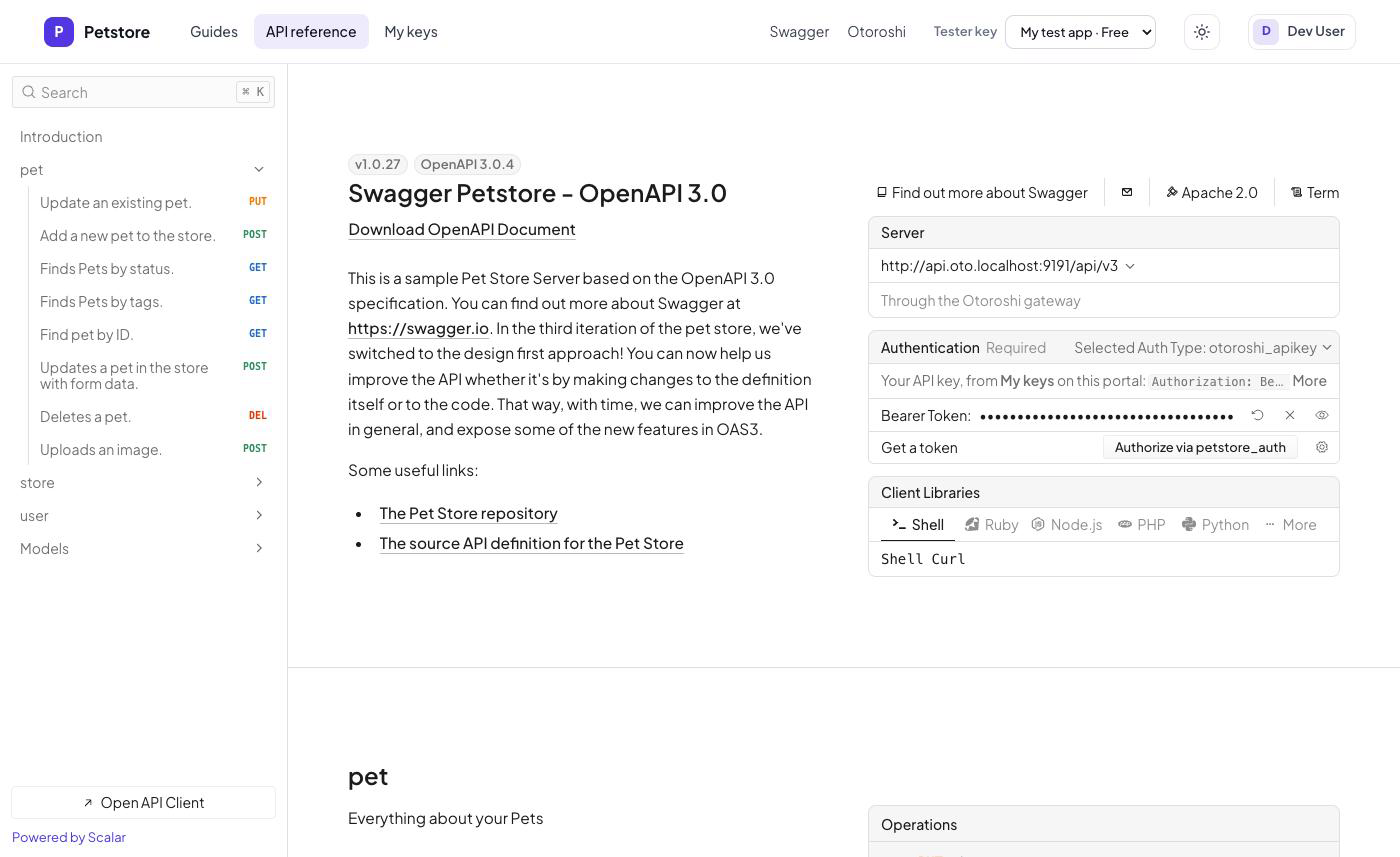
The API reference renders the specifications of the API with Scalar, and its client lets developers send requests from the portal.
Specifications
Each entry of references points at a specification, JSON or YAML:
| Field | Type | Description |
|---|---|---|
title | string | Its name |
link | string | The path of the resource with the specification (e.g. /openapi.json), or an https:// address |
description | string | Its summary, on its card |
icon | object | Its icon on its card ({ "css_icon_class": "bi bi-rocket" }) |
With one specification, /api-references shows it. With several, it lists them, and each one is at
/api-references/<link>. A resource with "transform": "scalar" is also shown as a specification.
The specification the reference reads
The reference reads the specification through the portal (/api/openapi?link=<link>), with:
- the gateway of the API as its first server:
<scheme>://<domain of the API><context path of the API>, with the scheme and the port the portal is read with. The servers of the specification follow, their relative addresses made absolute. Turn it off withportal.reference.gateway_server: false. - the keys of the developers as its security scheme, when the API has
apikeyplans:otoroshi_apikey, a bearer token (Authorization: Bearer <key>), required by the specification and offered on the operations that ask for their own security.
The key of the reference
A signed in developer picks one of their keys in the top bar (Tester key): it is put in the authentication of the reference for this tab. Use it in the reference, on a key of My keys, does the same in one click. A signed out developer sees Sign in to use your keys instead.
Where the requests go
The requests sent from the reference go through the portal (/api/_proxy, the proxyUrl of
Scalar):
- the browser needs no CORS from the API
- the portal only sends them to the hosts of the API: the domain of the API and the servers of
its specifications. Anything else is refused (
403) - the cookies of the portal are never sent; a cookie the developer sets in the client is
- the response comes back as the API gave it, without what would apply to the portal itself
(
Set-Cookie,Strict-Transport-Security…)