Overview
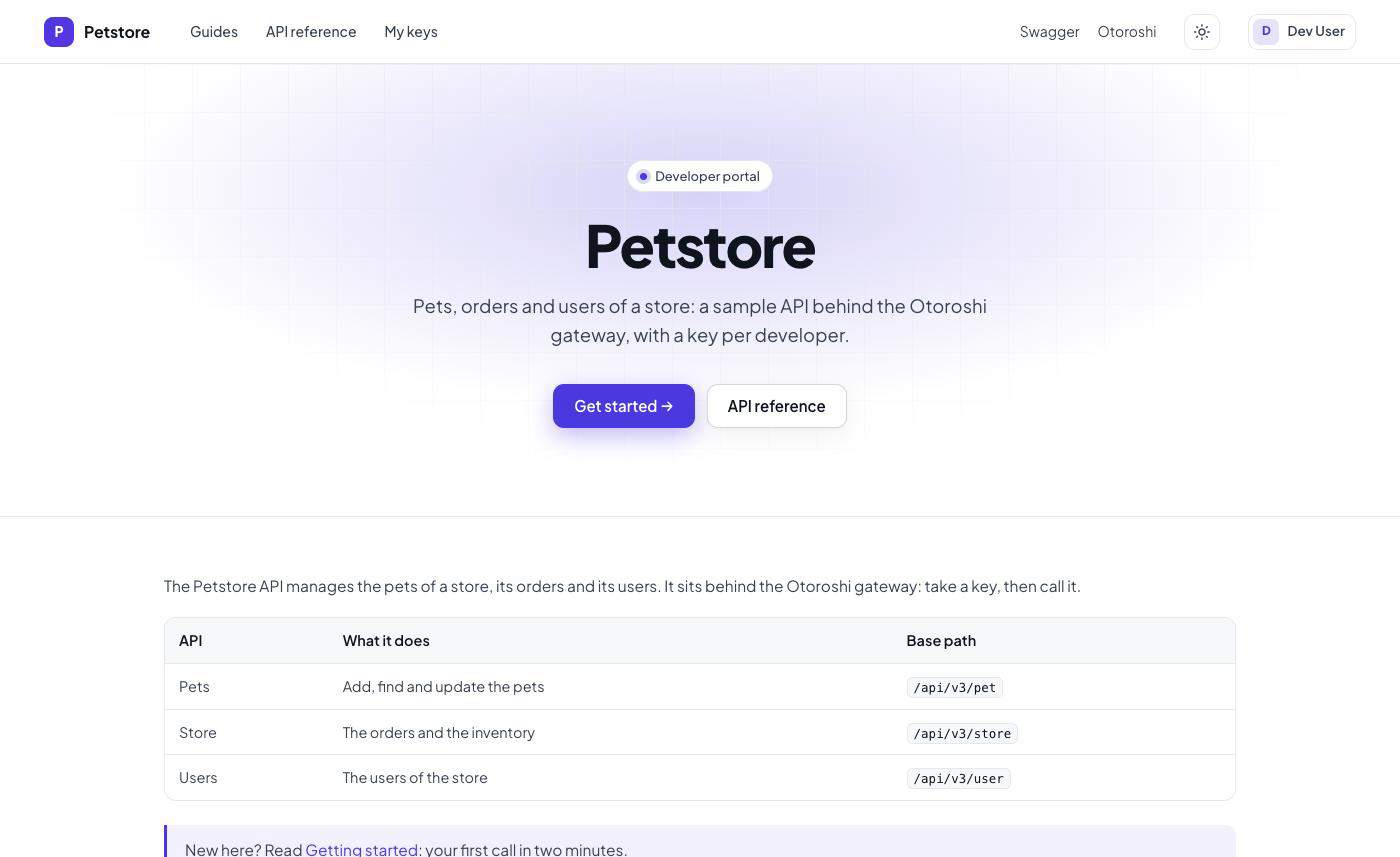
The Otoroshi API Portal is a set of two Otoroshi plugins that serve developer portals for the APIs you expose through the gateway: their documentation, an API reference you can send requests from, and self-service API keys. It has the look and the features of the developer portals of Cloud APIM Serverless.
Why it sits in the gateway
A developer portal usually means a frontend to deploy, a database of its own, and a synchronisation with the gateway that issues the keys. This one is a plugin of the gateway:
- nothing else to run: the pages are served by Otoroshi, on the route you give them
- configuration as data: the portal is the
documentationsection of an Otoroshi API, or a JSON file loaded from a URL, so it can live in git next to your API - real keys: a key taken on the portal is an Otoroshi subscription to a plan of the API, and the API key Otoroshi makes from it — the same entities you manage in the admin
Two plugins
Otoroshi API Portal
The portal of one API, on its own domain (or under a path prefix): a home, guides, the API reference, and the keys of the developer.
Otoroshi API Portal Catalog
A portal for several APIs, picked by id, tags or metadata: a home listing them with a search,
the keys of the developer for all of them, and the portal of each API under /apis/<slug>.
What a developer gets
| Guides | Markdown or HTML pages, inline or fetched from a URL, with a sidebar, a table of contents, highlighted code and previous / next links |
| API reference | Your OpenAPI specifications rendered with Scalar, and its client to send requests, through the portal to the Otoroshi gateway |
| API keys | Plans shown as cards, a key at once or on approval, its usage against its quotas, its secret rotated, ready-to-paste requests in curl, JavaScript and Python |
| One sign in | Your Otoroshi auth module: the portal stays public, developers sign in to take keys |
What you configure
| An API | An Otoroshi API (apis.otoroshi.io/Api) with a documentation section, and the plans developers take keys of |
| A route | An Otoroshi route on the domain of the portal, with an auth module and the portal plugin |
| The look | A few portal.* metadata: title, accent color, theme, links, terms of use… |
→ Install · Quickstart