Catalog of APIs
The Otoroshi API Portal Catalog plugin serves one portal for several APIs:
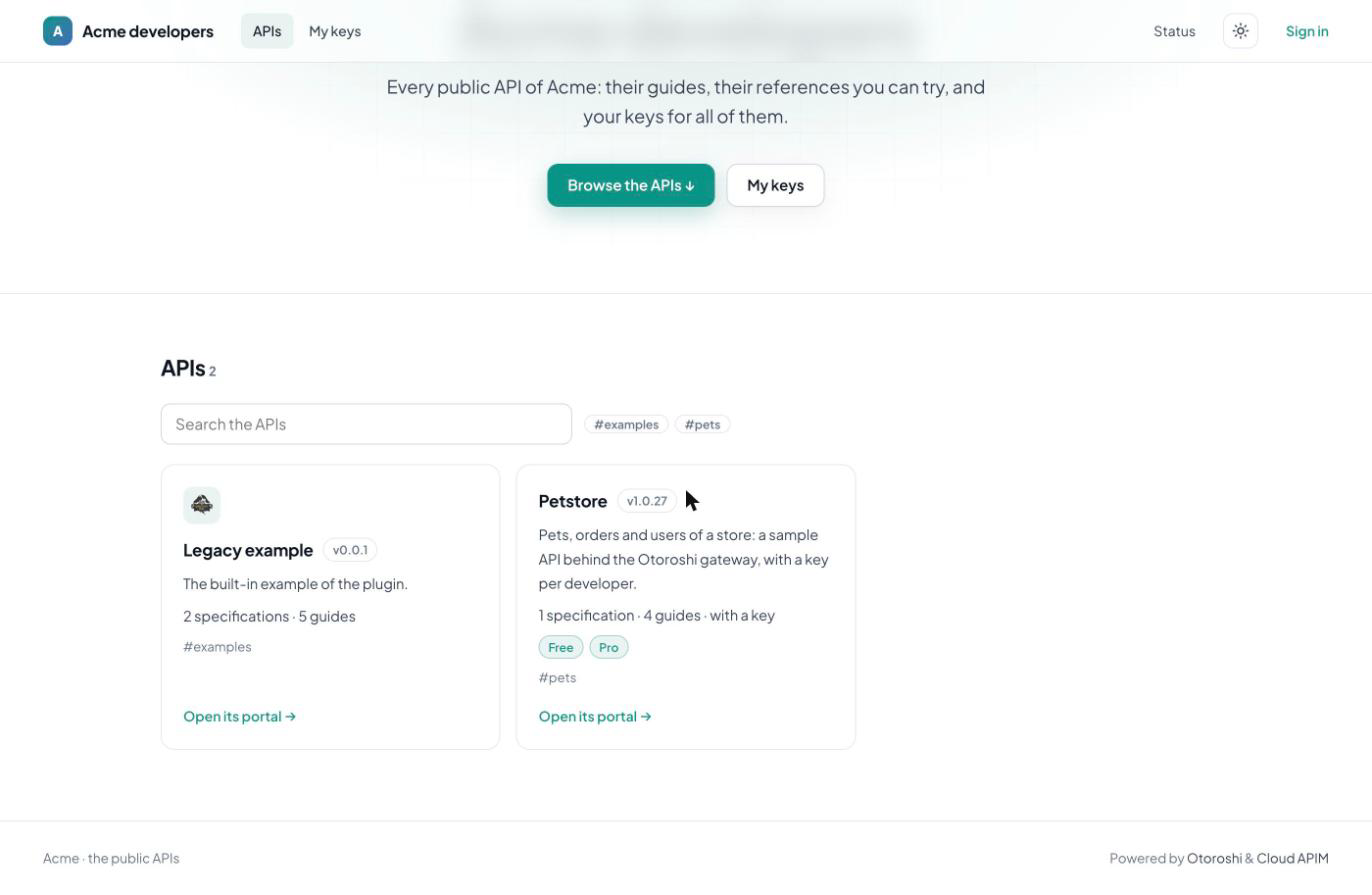
- a home with the APIs — their name, version, description, plans, tags — and a search by text or tag
- My keys for all of them: the developer picks an API, then one of its plans, and sees all their keys in one place
- the portal of each API under
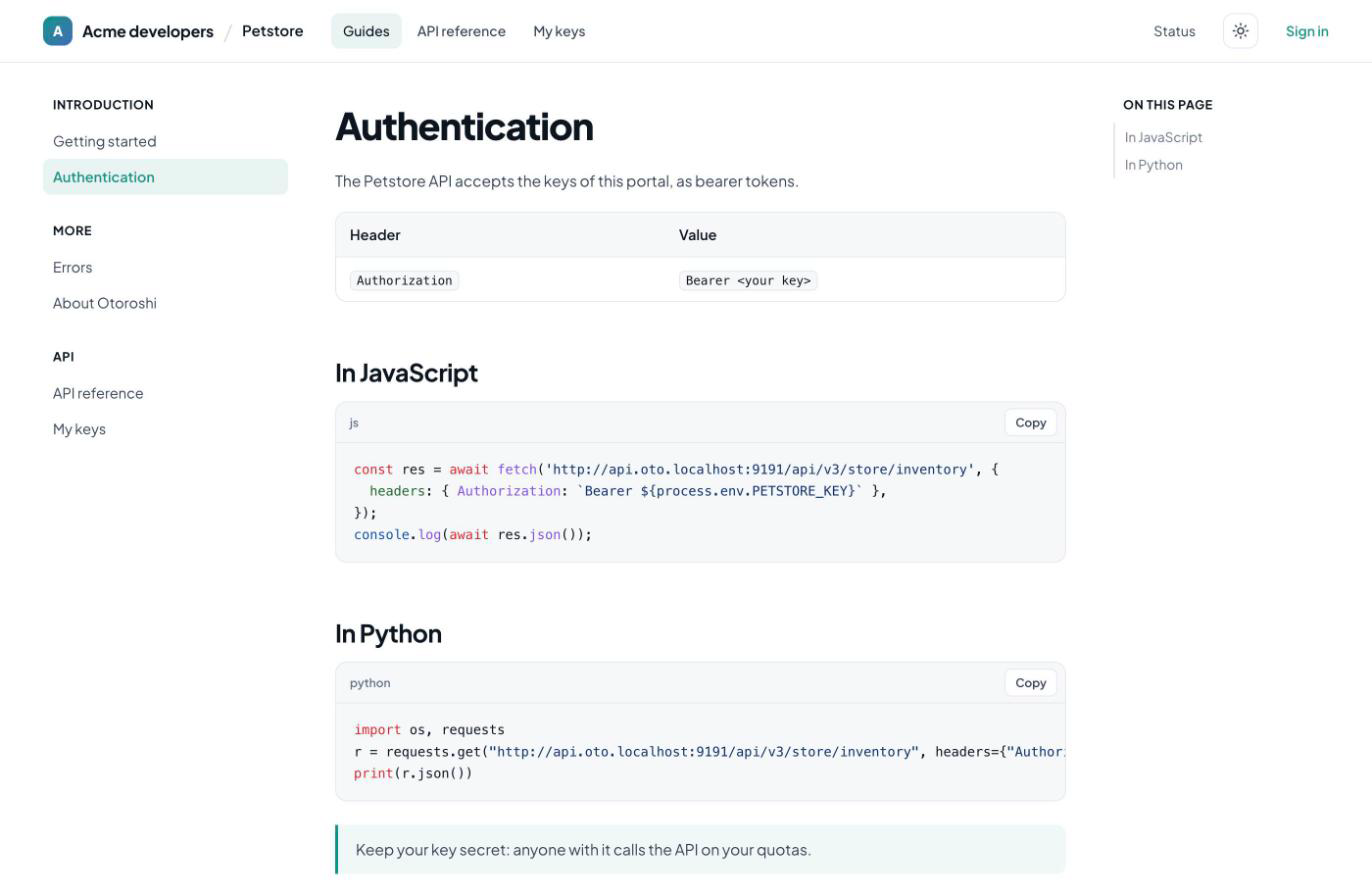
/apis/<slug>: the very same pages as the portal of a single API, with the top bar of the catalog and the API in a breadcrumb
A developer signs in once, at the catalog.
The route
The same chain as the portal of a single API, with the catalog plugin instead:
{
  "frontend": { "domains": ["developers.example.com"], "strip_path": true, "exact": false },
  "backend": { "targets": [{ "hostname": "request.otoroshi.io", "port": 443, "tls": true }] },
  "plugins": [
    { "plugin": "cp:otoroshi.next.plugins.OverrideHost", "enabled": true, "config": {} },
    { "plugin": "cp:otoroshi.next.plugins.NgAuthModuleUserExtractor", "enabled": true, "config": { "module": "<auth-module-id>" } },
    { "plugin": "cp:otoroshi.next.plugins.AuthModule", "enabled": true, "include": ["/login"], "config": { "module": "<auth-module-id>" } },
    {
      "plugin": "cp:otoroshi_plugins.com.cloud.apim.plugins.apiportal.OtoroshiApiPortalCatalog",
      "enabled": true,
      "config": {
        "title": "Acme developers",
        "description": "Every public API of Acme, and your keys for all of them.",
        "tags": ["public"],
        "accent": "#0d9488",
        "links": [{ "label": "Status", "url": "https://status.example.com" }],
        "footer": "Acme · the public APIs"
      }
    }
  ]
}
Its configuration
| Field | Type | Description |
|---|---|---|
prefix | string | Optional path prefix if the catalog is not served at the root of the domain |
api_refs | string[] | The ids of the APIs of the catalog |
tags | string[] | The APIs with all these tags |
metadata | object | The APIs with all these metadata |
title | string | The name of the catalog (Developer portal by default) |
description | string | The pitch of its home |
logo | string | The address of its logo |
theme | string | system (default), light or dark |
toggle | boolean | false hides the light / dark button |
accent | string | The accent color, like #0d9488 |
links | object[] | Links of the top bar: [{ "label": "...", "url": "https://..." }] |
footer | string | The text of the footer |
Its APIs
An API is in the catalog when:
- it is listed in
api_refs, or it has all thetagsandmetadatagiven — every API when none of the three is given - it is published (or deprecated): its routes are live
- it has an enabled
documentation - it is not
private, unless listed by id
The tags used to select the APIs are not shown on their cards (they all have them). Each API gets a
slug: the portal.slug metadata of its documentation (or of the API), or its name. Its portal is
under /apis/<slug>, and /keys?api=<slug> opens My keys with that API chosen.
Look and settings
The look of the catalog — theme, accent, links, logo — applies to the portals of its APIs, so they
read as one site. The other settings of each API (portal.title, portal.description,
portal.reference.*, portal.keys.*, portal.terms, its footer and banner) still apply to its own
pages.
The paths of the documentation of an API are served under /apis/<slug>: a /docs/errors link in a
page of the Petstore API goes to /apis/petstore/docs/errors.