Overview
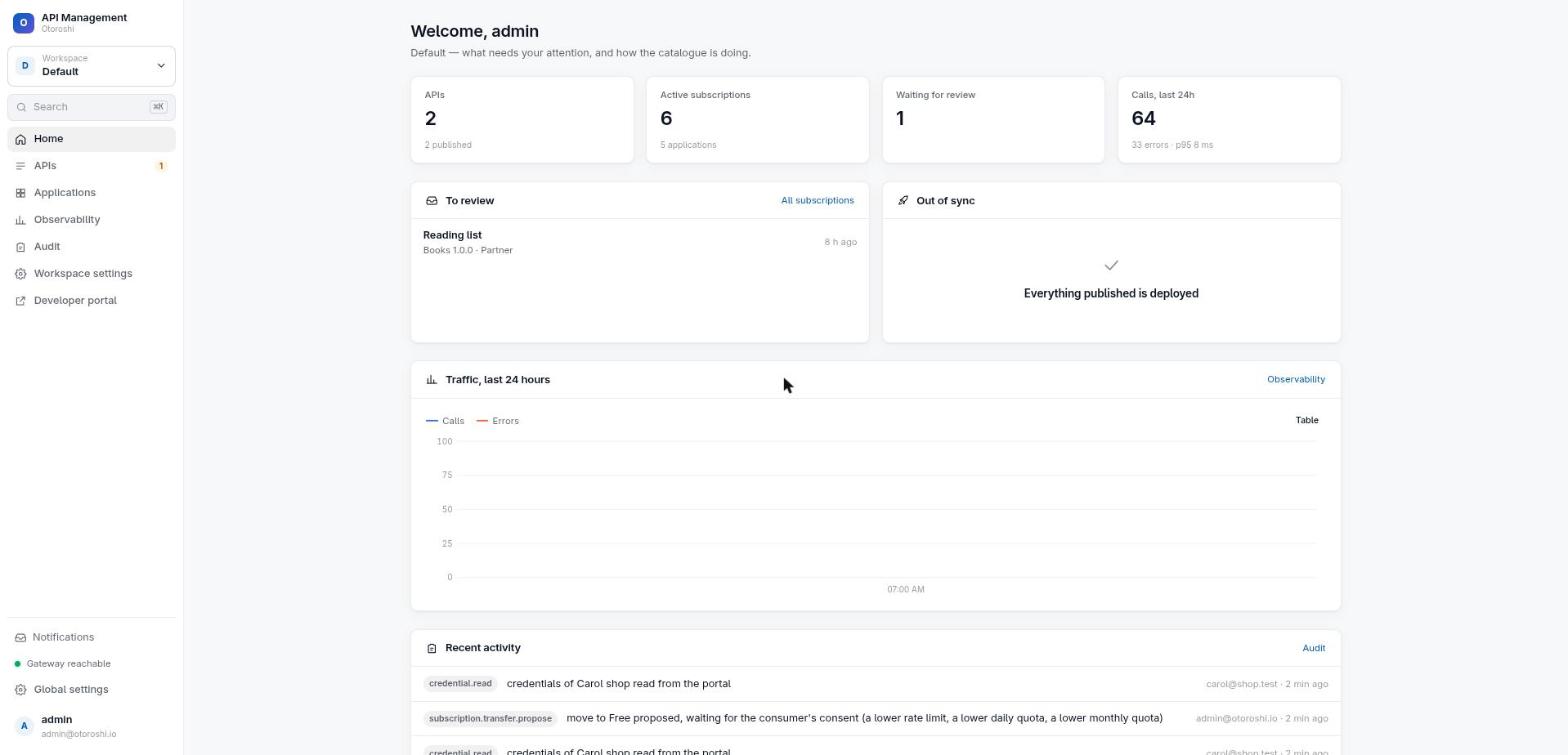
Otoroshi API Management is the API management console and the developer portal for the Otoroshi API gateway. Otoroshi routes, authenticates, throttles and observes traffic; this product describes APIs as products — documented, versioned, subscribable offerings with plans, approval workflows, credentials, a public catalogue and usage reporting — and drives the gateway to enforce them.
The ambition: to do API management, you no longer need to connect to Otoroshi. The product creates an API end to end, routes and backends included. No longer need to is not no longer able to: every projected Otoroshi entity stays readable, reachable and reclaimable by hand.
0.1.1 is a beta. It runs against Otoroshi 18.1, and the gaps it found in the gateway that are still open are listed in known limitations.
Four components, one binary
| Component | Path | What it is |
|---|---|---|
| Console | /backoffice | producers describe APIs, plans and documentation, publish and deploy, review subscriptions, watch usage |
| Developer portal | /<workspace>/ | consumers browse the catalogue, read the docs, try the API, subscribe, get credentials, follow their usage |
| Admin API | /api | the only way to do anything in the product — the console uses the very same router |
| Ingester | /ingest | receives Otoroshi events and stores them attributed to APIs, plans, subscriptions and applications |
They are four roles of a single binary — a fifth, controller, reconciles the
Kubernetes resources of the product: a deployment can carry all of them or
split them across instances. See Install.
The principles
The product is never in the request path. It projects policies into Otoroshi through its Admin API; Otoroshi enforces them. It is never called per request to decide whether a consumer may pass. Product operations are asynchronous and replayable: a projection that cannot reach the gateway waits in a queue and runs when the gateway is back. If the product is down, traffic still flows.
Policy lives in the plan; the route is a projection detail. Target, TLS, timeouts and load balancing belong to the route; auth mechanism, rate limit, quota, resource filtering and visibility belong to the plan. Adding a tier is a catalogue operation, never an infrastructure one.
You edit a draft, publish a snapshot, deploy the snapshot. A draft never reaches the gateway. Publishing freezes an immutable snapshot; deploying projects it; rolling back is deploying an earlier one.
Synchronisation is selective. Only what the gateway needs to enforce is pushed to it. Documentation, catalogue visibility, terms of use, usage statements, pricing and metadata stay in the product.
The abstraction is additive and transparent. From any API you reach the Otoroshi entity it projects; drift made by hand on the gateway is detected and shown; an existing Otoroshi API can be adopted without being overwritten.
Everything is administrable by program. The console is a client of the admin API, so every action replays from the CLI. APIs are declarative documents, and remote catalogs reconcile them from HTTP, git or S3.
One installation drives one Otoroshi cluster. Geography is carried by Otoroshi's own leader/worker cluster; each environment is its own installation.
Lists
Every list of the console and of the developer portal is searched and paged — the APIs, the
subscriptions, the workspaces, the teams, the tokens, and the lists inside a page too: the
versions of a shared policy group, the resources of an API, the credentials of a subscription. The
search and the page are kept in the url, so a filtered list is a link to bookmark or share; in a
modal or a drawer, in the list itself. The lists that grow are searched and paged on the server
(the audit trail, the request log, the people, the deployment history of an API, the usage billed
for a subscription): the admin API takes ?q=, ?limit= and
?offset=.
Languages
The console and the developer portal speak English and French. Each follows the language of the browser; the user menu changes it, and the browser remembers the choice. The content itself — documentation pages, the texts of a portal — is written in as many languages as the workspace wants. The admin API answers in English: an error or a validation message it returns is shown as it is.
Architecture
console (/backoffice) ─┐                     ┌─ portal (/<workspace>/, /front/api)
                       ▼                     ▼
                admin api (/api)  ──  draft · snapshots · deployments · plans
                       │              subscriptions · applications · audit
                       │  task queue (asynchronous, replayable)
                       ▼
            Otoroshi Admin API — Api entity (written as code), ApiSubscription → apikey
                       │
         Otoroshi (data plane) ── data exporter ──▶ ingester (/ingest) ──▶ analytics database
Two PostgreSQL databases: one for the application data, one for events and analytics.
Where to go next
- Quickstart — an installation on your machine, and a first API called through the gateway
- Tutorial — an API exposed from the console, subscribed to and called by a consumer alone, a screen at each step
- Concepts — workspaces, APIs, plans, subscriptions
- The developer portal, and its design — the default template, a theme, or templates
- The gateway side — what is written to Otoroshi, and what never is
- Known limitations of the data plane